The Thermodynamics of SaaS: Why Codebases Decay and How We Prevent It
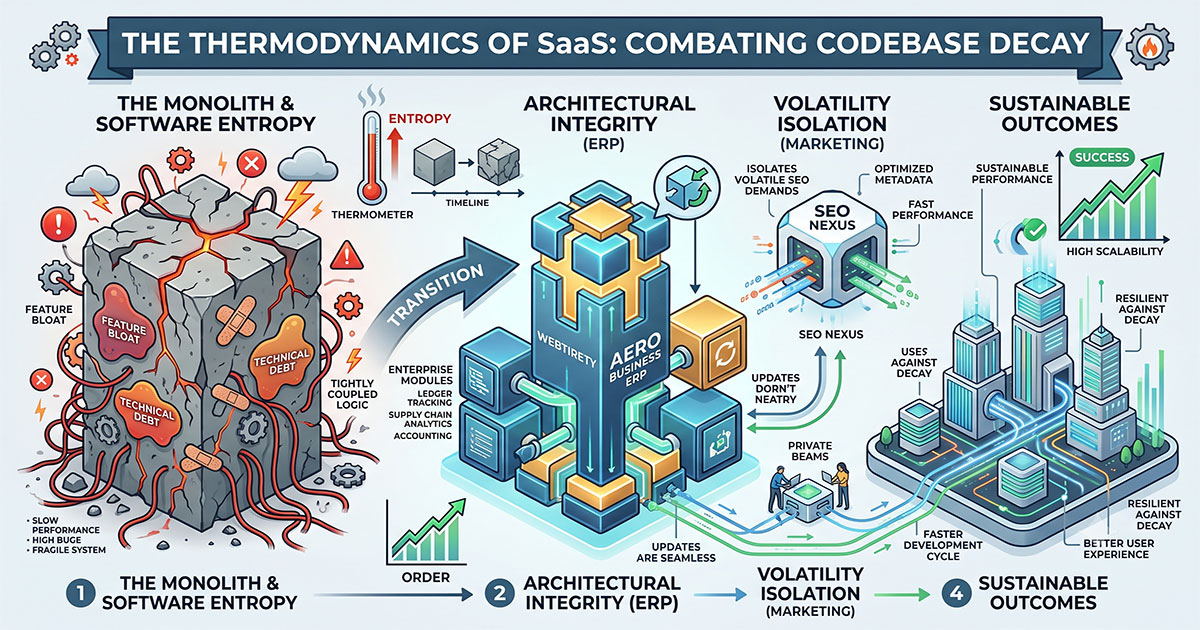
In physics, the Second Law of Thermodynamics dictates a universal truth: in any closed system, entropy a measure of disorder will inevitably increase. Over time, heat dissipates, structures crumble, and order yields to chaos unless external energy is applied to maintain it.
In the digital realm, we experience a striking parallel. We call it software entropy.
When a SaaS product is first launched, the codebase is pristine. The architecture is logical, the dependencies are clean, and the vision is unified. But as months turn into years, new features are bolted on, quick fixes are applied to meet deadlines, and user requirements shift. Without a deliberate strategy to combat it, the once-elegant architecture devolves into a tangled monolith. The system slows down, bugs multiply, and the user experience degrades.
Here is why SaaS codebases decay, and the engineering philosophies required to keep systems running efficiently.
The Forces of Software Entropy
Unlike physical machines, software doesn't wear out from friction or rust. It decays from change. The primary drivers of software entropy include:
- Scope Creep and Feature Bloat: Adding features outside the original architectural design forces developers to create complex workarounds.
- Technical Debt: Prioritizing speed of delivery over code quality creates a "loan" that accrues interest over time, making future changes exponentially harder.
- Tightly Coupled Logic: When different parts of an application are too deeply intertwined, changing a single variable in a marketing script can break a core accounting function.
Just as a physical system requires continuous energy to maintain its structure, a SaaS platform requires the continuous application of intelligent design, refactoring, and modular thinking to stave off decay.
Combating the Chaos: The Webtirety Approach
Preventing software entropy requires moving away from rigid, monolithic architectures and embracing modularity. By isolating functions, we can update, expand, or replace individual components without destabilizing the entire ecosystem.
1. Architectural Integrity in Aero Business ERP
Enterprise resource planning systems are notoriously susceptible to bloat because they must handle complex, multi-faceted business operations. To prevent entropy from taking hold, Aero Business ERP is built on a foundation of strict architectural isolation.
Instead of a single, massive codebase where every feature interacts with every other feature, the platform utilizes dedicated enterprise modules. Whether managing intricate FIFO ledger tracking or handling supply chain analytics, each module operates as a self-contained unit. This means that expanding the capabilities of one enterprise module does not introduce chaotic variables into the core ERP framework. The system remains scalable, fast, and resilient against decay.
2. Injecting Order into Marketing with Webtirety SEO Nexus
Marketing and frontend performance optimization are frequent culprits of code decay. SEO strategies, Open Graph optimization, and metadata requirements are constantly shifting. When these elements are hardcoded directly into the main application logic, the codebase becomes fragile.
Webtirety Nexus functions as a localized counter-force to this specific type of entropy. By providing a structured, highly optimized environment for SEO and metadata management, it isolates the volatile, ever-changing demands of search engines from the core application logic. This ensures that the user experience remains lightning-fast and visually cohesive, while marketing teams have the flexibility they need without introducing technical debt into the backend.
The Continuous Investment of Energy
The universe naturally bends toward disorder, and software is no exception. A decaying codebase is not a sign of initial failure, but rather a symptom of growth without a maintenance strategy.
Building sustainable SaaS is about recognizing that order is not a default state. It requires the continuous, deliberate application of energy: regular code refactoring, rigorous UI/UX audits, and an unwavering commitment to modular design. By treating software architecture as a living system that requires active thermodynamic management, we can build platforms that don't just survive scale - they thrive in it.
Frequently Asked Questions
Want to discuss this concept?
Share your perspectives or join the conversation with us on public networks.