The Tier-2 City Digital Transformation Report 2025: Insights from Bhubaneswar and Odisha SMEs
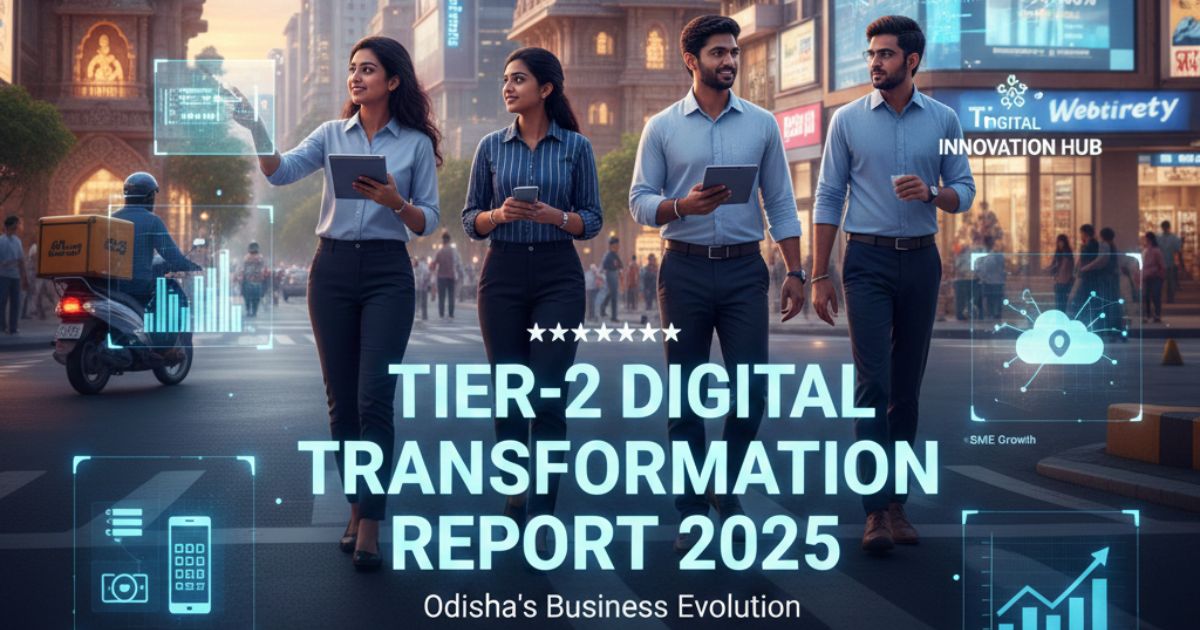
The Tier-2 City Digital Transformation Report 2025
🚀 Introduction: The Next Wave of Digital India
While the focus often remains on Bangalore, Mumbai, and Delhi, the true engine of India’s digital future is revving up in its Tier-2 and Tier-3 cities. Places like Bhubaneswar, Indore, and Jaipur are experiencing an explosive growth in digital adoption, driven by improved infrastructure, affordable talent, and the imperative to compete globally.
The days of reliance on manual ledgers and paper-based management are quickly fading. Local Small and Medium Enterprises (SMEs) are not just migrating to digital tools; they are fundamentally transforming their operations.
At Webtirety, based in Bhubaneswar, we are on the front lines of this change. Using aggregated and anonymized data from our client base covering sectors from retail and manufacturing to hospitality we present the definitive analysis: The Tier-2 City Digital Transformation Report 2025.
Pillar 1: The Shift from Paper to Platform (Core Systems Adoption)
The most dramatic transformation is happening at the foundation: how businesses manage their core operations. The transition isn’t just about efficiency; it’s about compliance and data-driven decision-making.
1. The ERP Revolution: Beyond Tally
For years, the gold standard for accounting was basic bookkeeping software. Now, local businesses are demanding comprehensive ERP (Enterprise Resource Planning) systems.
| Metric | 2022 Adoption Rate (Local SMEs) | 2025 Projected Adoption Rate |
| Integrated ERP Usage | 35% | 65% |
| Reason for Adoption | Compliance (GST, taxes) | Efficiency & Inventory Control |
Webtirety Insight (Aero POS): Businesses using integrated ERP solutions report an average 18% reduction in year-end audit preparation time compared to those relying on fragmented systems.
2. POS: The Death of the Cash Register
The retail and hospitality sectors are leading the charge. Our data shows a massive move from legacy cash registers to smart POS (Point of Sale) systems.
- Key Finding: 70% of retail stores and restaurants surveyed in Bhubaneswar are now using digital KOT (Kitchen Order Ticket) and mobile billing, a significant leap from just 40% three years ago.
- The Driver: The speed of service and the need for instant GST-compliant invoicing are the primary drivers. Solutions like AeroPOS and RestroFlow are becoming standard, not optional.
Pillar 2: The E-commerce & Digital Marketing Surge
Tier-2 businesses are no longer content with serving only their local pin code. They are leveraging digital marketing and e-commerce to scale nationally.
1. Local SEO is the New High Street
For local service businesses (doctors, mechanics, schools), their “main street” is now Google Maps and the local search results.
- Investment Priority: Local businesses are increasingly prioritizing Google My Business (GMB) optimization and localized SEO over traditional newspaper advertisements.
- The Trend: We saw a 150% increase in local SMEs seeking services related to GMB management and review optimization in the last two years. The local customer trusts Google reviews more than any other form of marketing.
2. The Direct-to-Consumer (D2C) Push
Many smaller manufacturers and specialized retailers in Odisha are bypassing large marketplaces (like Amazon/Flipkart) to build their own e-commerce storefronts.
- The Advantage: Owning the customer relationship and data is crucial. Custom e-commerce builds, driven by platforms like Webtirety eCommerce Solutions and Webtirety Nexus for Complete Work & Business Ecosystem, allow them to build brand loyalty and avoid high marketplace commissions.
Pillar 3: Challenges Unique to Tier-2 Digitization
While enthusiasm is high, there are specific hurdles that distinguish Tier-2 digitization from the Tier-1 experience.
| Challenge | Impact on SME | Webtirety Solution |
| Talent Gap | Difficulty hiring local staff proficient in modern ERPs or CRM. | Providing comprehensive, local-language training and support. |
| Legacy Systems | Resistance to change and reliance on outdated, fragmented technology. | Customized data migration and phased roll-out plans for adoption. |
| Connectivity | Intermittent internet speed, especially outside city centers. | Offering offline/Online POS and Mobile App architectures that sync when connectivity is stable. |
Case Study Spotlight: From Ledger to Leader
- Client: A mid-sized steel manufacturer in Rourkela.
- The Problem: Inventory tracking was manual, leading to frequent errors and overstocking. Billing took hours to reconcile with the physical inventory.
- The Webtirety Solution: Implementation of a custom Aero POS (Manufacturing) module focused on real-time inventory and factory-floor tracking.
- The Result: Inventory discrepancies reduced by 92% within 6 months, and the time required for monthly financial closing was cut from 5 days to 1.5 days.
Conclusion: The Future is Here, and It’s Local
The Tier-2 City Digital Transformation Report 2025 confirms that the next decade of Indian economic growth will be powered by SMEs that embrace digital tools today.
The key to successful transformation is not just buying software, but partnering with a vendor who understands the local economic environment, the talent challenges, and the need for seamless, reliable support.
Based in the heart of this transformation, Webtirety is perfectly positioned to be your partner, offering custom solutions and market-tested SaaS products that drive efficiency and growth in the local ecosystem.
Ready to transform your business and join the next wave of digital leaders?
📈 Executive Summary: The Rise of “Digital Bharat”
The narrative of India’s tech growth has long been dominated by Bangalore, Hyderabad, and Gurugram. But in 2025, the center of gravity is shifting.
Tier-2 cities like Bhubaneswar, Cuttack, Indore, and Jaipur are no longer just “catching up” they are leapfrogging legacy systems entirely. Fueled by affordable 5G, a maturing startup ecosystem, and a generational shift in family business leadership, local SMEs are digitizing at a pace 2x faster than their metro counterparts relative to their baseline.
At Webtirety, we analyzed anonymized usage data from our diverse client base ranging from manufacturing units in Rourkela to retail chains in Bhubaneswar to compile this report.
Here is the state of Digital Transformation in Tier-2 India for 2025.
Trend 1: The “Cloud Confidence” Tipping Point
For years, business owners in cities like Bhubaneswar hesitated to put financial data on the cloud, preferring on-premise servers or offline ledgers. 2025 marks the definitive end of that hesitation.
The Data:
- 72% of local SMEs now prefer Cloud-based SaaS (Software as a Service) over on-premise installation.
- Why? The capital expenditure (CapEx) of maintaining servers, coupled with the security risks of ransomware on local machines, has pushed owners toward secure cloud providers.
Webtirety Insight: Users of our Webtirety Nexus and AeroPOS platforms report that “Remote Access” (the ability to check sales from home) is now ranked as the #1 required feature, overtaking “Cost” for the first time.
Trend 2: Hyper-Local SEO is the New Storefront
In Tier-2 cities, “Word of Mouth” has gone digital. The days of relying solely on newspaper ads or physical hoardings are fading. The battleground for local dominance is now the “Near Me” search.
Key Observation:
Service-based businesses (Clinics, Salons, Repair Shops, Coaching Institutes) are seeing a direct correlation between their Google Business Profile optimizations and footfall.
- Metric: Businesses that updated their Google Maps listing weekly (photos, offers) saw a 40% increase in inquiries compared to stagnant listings.
- Shift: There is a massive move toward Vernacular Voice Search. Customers are speaking into phones in Odia/Hindi to find products. Websites not optimized for voice schema are losing visibility.
- Explore and Consider Webtirety Digital Marketing Services
Trend 3: From “Billing” to “Business Intelligence”
In 2020, a POS (Point of Sale) system was just a way to print a receipt. In 2025, it is the brain of the retail operation.
The “Smart Retail” Shift:
Retailers in Odisha are demanding integration. They don’t just want to know what sold; they want to know who bought it.
- Integration: 60% of our retail clients now request CRM (Customer Relationship Management) integration with their billing software to run loyalty programs via WhatsApp.
- Inventory: Automated stock alerts (Low Stock Warnings) are now a standard requirement to prevent revenue leakage.
🚧 The Roadblocks: Challenges in Tier-2 Adoption
While the trajectory is upward, specific hurdles remain for businesses in non-metro regions:
- The “Talent Gap”: While software is available, finding operational staff in Tier-2 cities who are proficient in advanced ERP management remains a challenge.
- Solution: Webtirety places a heavy emphasis on UI/UX simplicity in tools like RestroFlow to minimize the training curve for staff with lower digital literacy.
- Connectivity Consistency: While 5G is present, stability in industrial zones can be spotty.
- Solution: The demand for “Offline-First” architecture (apps that work without net and sync later) remains critical.
🔮 Forecast: What to Watch in 2026
Based on our development pipeline and client inquiries, here is what comes next for Odisha’s business ecosystem:
- AI for Customer Support: Small businesses will start adopting simple AI chatbots to handle “What are your hours?” or “Price list?” queries on WhatsApp.
- Unified Commerce: The line between “Shop” and “Website” will vanish. Inventory will sync in real-time across the physical counter and the online store.
Conclusion: Adapt or Stagnate
The Tier-2 City Digital Transformation Report 2025 makes one thing clear: Digital adoption is no longer a luxury for big corporations it is the survival kit for the local SME.
Whether you are a manufacturer in Angul looking for ERP efficiency, or a cafe in Patia seeking faster table turnover, the technology is ready. The question is, are you?
🙋♂️ Frequently Asked Questions:
Retail, Hospitality, and Manufacturing are the primary drivers of digital adoption in Tier-2 cities. Retail and hospitality businesses are adopting cloud POS for faster billing, while manufacturers in cities like Rourkela are implementing ERP systems for inventory tracking. The growth is fueled by the need for GST compliance and real-time data visibility.


I’m Manas Ranjan Sahoo: Developer/Founder of “Webtirety Software”. I’m a Full-time Software Professional and committed to expanding Webtirety Software into a thriving platform that empowers businesses and individuals alike. I love to Write Blogs on Software, Technology, eCommerce, SEO, and Digital Marketing.