AI vs Machine Learning vs Deep Learning: What’s the Difference?
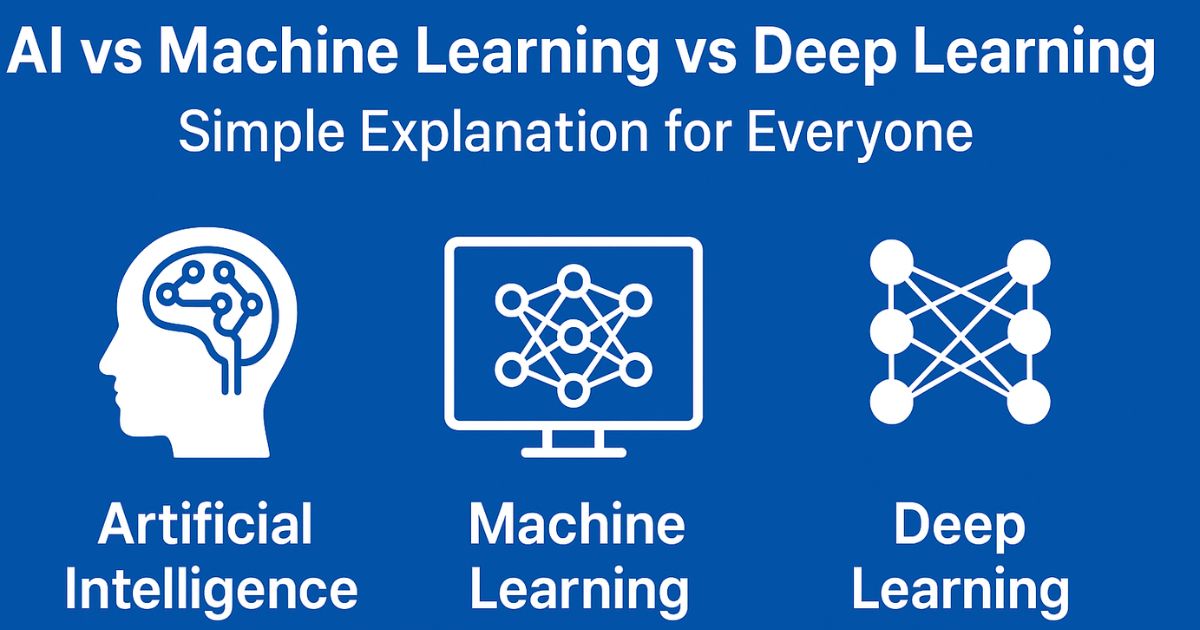
AI vs Machine Learning vs Deep Learning: What’s the Difference? (A Complete Simple Guide)
If you’ve been exploring the tech world or even just scrolling social media you’ve probably come across the terms Artificial Intelligence (AI), Machine Learning (ML), and Deep Learning (DL).
People often use them interchangeably… but nope, they’re not the same thing.
This guide breaks everything down in simple words, with clear examples, and friendly explanations designed for students, professionals, and business owners alike.
⭐ What Is Artificial Intelligence (AI)?
Artificial Intelligence (AI) is the broadest field.
It refers to any technology that allows machines to mimic human intelligence. For more broader explanation read this – What Is Artificial Intelligence? Simple Guide for Everyone (2026 Edition).
AI helps machines:
- Understand instructions
- Learn from data
- Reason and make decisions
- Solve problems
- Recognize speech, text, or images
- Interact like humans
Simple Example of AI
- Siri answering your questions
- Google Maps recommending a faster route
- Chatbots responding to customer queries
- Email apps detecting spam
How It Actually Works?
Artificial Intelligence is not a single technology it is a combination of multiple techniques that allow machines to simulate human intelligence. Learn how AI works behind the scenes.
🔧 Core Components of AI
AI systems usually rely on:
- Data – text, images, numbers, audio, or video
- Rules or Models – logic or learned patterns
- Decision-Making Engines – to choose the best action
- Feedback Loops – to improve performance over time
🧠 How AI Thinks (In Simple Terms)
- Receives input (example: a voice command)
- Processes it using predefined rules or learned behavior
- Produces an output (response, action, prediction)
Some AI systems are rule-based (if-this-then-that), while others are learning-based (Machine Learning).
AI does not “think” like humans – it calculates probabilities based on data.
⭐ What Is Machine Learning (ML)?
Machine Learning (ML) is a subset of AI.
ML allows computers to learn from data without being explicitly programmed.
Instead of writing rules manually, ML algorithms use patterns inside data to:
- Predict results
- Classify information
- Recommend items
Real-World Machine Learning Examples
- Netflix recommending movies
- Amazon suggesting products
- Credit card fraud detection
- Spam detection in Gmail
How Machines Learn from Data?
Machine Learning is where AI becomes smart instead of just programmed.
Instead of telling a computer what to do, you give it examples, and it learns patterns by itself.
⚙️ How Machine Learning Works (Step-by-Step)
- Data Collection
Example: emails labeled as “spam” or “not spam” - Feature Extraction
AI identifies patterns like:- Certain words
- Sender behavior
- Email frequency
- Model Training
Algorithms learn relationships between data and outcomes. - Prediction or Classification
New emails are classified as spam or safe. - Model Improvement
Feedback helps the model get better over time.
🧩 Types of Machine Learning
1. Supervised Learning
- Uses labeled data
- Example: predicting house prices, spam detection
2. Unsupervised Learning
- No labeled data
- Example: customer segmentation, behavior analysis
3. Reinforcement Learning
- Learns from rewards and penalties
- Example: game-playing AI, robotics
⭐ What Is Deep Learning (DL)?
Deep Learning (DL) is a subset of Machine Learning.
It uses neural networks – computer systems inspired by the human brain.
Deep Learning handles:
- Huge amounts of data
- Complex tasks beyond traditional ML
- Multi-layer neural networks (“deep” = many layers)
Examples of Deep Learning
- Self-driving cars
- Face recognition in smartphones
- DALL-E and Midjourney generating images
- Voice assistants understanding natural speech
How Neural Networks Mimic the Human Brain?
Deep Learning is a specialized form of Machine Learning designed to handle complex and large-scale data. It uses Artificial Neural Networks, inspired by the structure of the human brain.
🧠 What Are Neural Networks?
A neural network is made of layers of connected nodes (neurons):
- Input Layer – receives raw data
- Hidden Layers – process patterns
- Output Layer – produces final results
Each connection has a weight, and learning happens by adjusting these weights.
🔬 Why Is It Called “Deep” Learning?
Because it uses multiple hidden layers.
More layers =
✔ Better understanding of complex patterns
✔ Higher accuracy
✔ Ability to process images, speech, and video
Example:
- Early layers detect edges in an image
- Middle layers detect shapes
- Deep layers recognize faces or objects
⚙️ How Deep Learning Learns (Simplified)
- Data flows forward through the network
- Output is compared with the correct answer
- Errors are calculated
- The system adjusts weights using backpropagation
- This repeats thousands of times
This is why deep learning requires:
- Huge datasets
- Powerful GPUs
- More time to train
🔹 Why Deep Learning Outperforms Traditional ML
| Area | Traditional ML | Deep Learning |
|---|---|---|
| Feature Selection | Manual | Automatic |
| Data Size | Small–Medium | Very Large |
| Accuracy | Good | Excellent |
| Complexity Handling | Limited | Very High |
| Hardware Needs | Normal | High (GPU/TPU) |
🔹 Real-World Deep Learning Applications
- Computer Vision
Face recognition, medical imaging, surveillance - Natural Language Processing (NLP)
ChatGPT, Google Translate, voice assistants - Speech Recognition
Voice typing, smart assistants - Autonomous Systems
Self-driving cars, drones - Generative AI
Image, text, and video generation tools
🔹 How AI, ML & DL Work Together
Think of them like this:
- AI is the goal → make machines intelligent
- ML is one way to achieve AI → learning from data
- DL is a powerful ML method → learning with neural networks
➡ Deep Learning enables modern AI breakthroughs like ChatGPT, facial recognition, and autonomous vehicles.
🔹 When Should You Use AI, ML, or Deep Learning?
Use AI when:
- You need automation or rule-based decision systems
Use Machine Learning when:
- You have structured data
- Patterns can be learned
Use Deep Learning when:
- Data is large and unstructured
- You need image, speech, or text understanding
🔹 Takeaway
Artificial Intelligence is the broader concept of smart machines, Machine Learning enables systems to learn from data, and Deep Learning uses neural networks to solve complex problems with high accuracy.
🔍 AI vs Machine Learning vs Deep Learning: Easy Comparison
| Feature | Artificial Intelligence | Machine Learning | Deep Learning |
|---|---|---|---|
| Definition | Broad concept of machines behaving intelligently | Machines learning from data | Neural networks learning from huge data |
| Complexity | Broad-level systems | Medium | High |
| Data Requirement | Low–Medium | Medium | Very High |
| Examples | Chatbots, automation | Spam filter, recommendations | Face ID, self-driving cars |
🎯 Which One Should You Learn First?
If you’re just starting out:
- Start with AI basics
- Learn Machine Learning concepts
- Move to Deep Learning once you’re comfortable with ML
Perfect for tech careers like:
- AI engineer
- ML developer
- Data analyst
- Automation specialist
💡 AI, ML, and DL in Daily Life
AI in Daily Life
- Google Search
- Smart home devices
- Banking chatbots
Machine Learning in Daily Life
- YouTube recommendations
- Fitness apps predicting steps/calories
Deep Learning in Daily Life
- Face unlock
- Real-time language translation
- Autonomous vehicles
💼 AI, ML & DL for Business
Businesses use these technologies to:
- Improve customer experience
- Automate repetitive tasks
- Analyze data faster than humans
- Reduce costs and errors
- Predict market trends
Popular business applications:
- CRM automation
- Predictive sales analytics
- Customer segmentation
- Marketing automation
- Fraud detection
🎓 AI, ML & DL for Students
Why students should care:
- Huge career growth
- High salaries
- Works in every industry
- Perfect for freelancing, research, startups
Useful areas to explore:
- Python programming
- Data science
- Neural networks
- Natural Language Processing (NLP)
📌 Final Summary
Here’s the simplest way to remember it:
👉 AI = The big umbrella
👉 ML = One branch of AI
👉 DL = A powerful branch inside ML
Or even simpler:
AI is the overall intelligence → ML is the process of learning → DL is learning with neural networks.
🙋♂️ People Also Ask: AI vs Machine Learning vs Deep Learning
Artificial Intelligence is the broader concept of creating machines that can perform tasks requiring human intelligence, while Machine Learning is a subset of AI that enables systems to learn from data and improve performance automatically without explicit programming.
Deep learning is more powerful than traditional machine learning for complex tasks like image recognition and language processing, but it requires large datasets and high computing power. Machine learning works better for simpler, structured data problems.
Yes. Artificial intelligence can exist without machine learning through rule-based systems, but such AI cannot learn from data or improve automatically, making it less flexible and less effective for complex tasks.
ChatGPT is an artificial intelligence system built using deep learning, which is a subset of machine learning that uses neural networks trained on massive datasets to understand and generate human-like text.
A common example of deep learning is facial recognition technology, where neural networks analyze thousands of images to accurately identify and verify human faces in real-world applications.
Artificial intelligence concepts are the easiest to learn, machine learning requires basic programming and mathematical understanding, and deep learning is the most challenging due to neural networks and advanced mathematical models.
You can learn basic artificial intelligence concepts without coding, but practical machine learning and deep learning applications require programming knowledge, typically in languages like Python.


I’m Manas Ranjan Sahoo: Developer/Founder of “Webtirety Software”. I’m a Full-time Software Professional and committed to expanding Webtirety Software into a thriving platform that empowers businesses and individuals alike. I love to Write Blogs on Software, Technology, eCommerce, SEO, and Digital Marketing.