
The Hidden Agency Revenue Stream: Combating Content Entropy
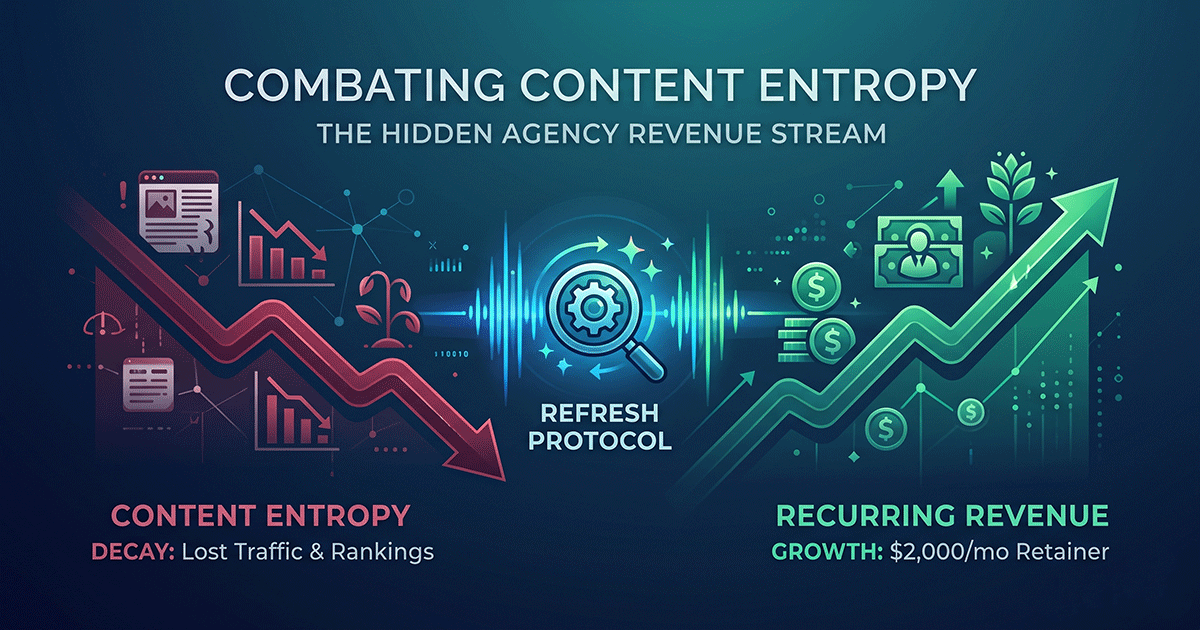
Most digital agencies are caught in a relentless cycle of one-off projects. You sell a comprehensive website build, execute an initial technical SEO audit, hand over the deliverables, and then scramble to find the next client.
Scaling a sustainable agency requires shifting from project-based income to recurring revenue. One of the most ethical, high-impact ways to secure a monthly retainer is by solving a silent problem your clients do not even realize they have: Content Entropy.
The Physics of Content Decay
In physics, entropy is the natural tendency of a system to move from order to disorder. Left unattended, everything degrades.
This exact principle applies to digital marketing. Content is not a permanent monument; it is a battery that slowly loses its charge. A blog post that you successfully ranked #1 for a client six months ago is actively decaying.
Several factors accelerate this digital entropy:
- Search Intent Shifts: What users are looking for changes over time.
- Competitor Upgrades: Rival sites publish longer, more data-rich content.
- Algorithmic Preferences: Search engines heavily favor fresh, updated content to ensure users get the most current answers.
Before your client realizes it, their biggest organic traffic driver has slipped to Page 2, and their lead pipeline begins to dry up.
Stop Selling “New” Content (Sell Protection Instead)
When agencies try to upsell existing clients, the default pitch is usually, “Let’s write four new blog posts a month.”
Clients are often hesitant to sign off on this because new content is inherently a gamble. It takes time to index, time to build authority, and there is no guarantee it will rank.
Instead of selling a gamble, sell protection.
Imagine telling a client: “We’ve identified that you are currently losing 30% of your organic traffic on your top five historical posts due to content decay. We are going to implement a protocol to protect and revitalize the assets that are already making you money.”
| Strategy | Client Risk | ROI Timeline | Predictability |
| Pitching New Content | High | 3 to 6 Months | Low |
| Combating Content Entropy | Low | 72 Hours to 2 Weeks | High |
The Content Refresh Protocol: A 4-Step Playbook
To turn this concept into a $2,000/month recurring retainer, you need a systematic approach to identifying and reversing decay.
1. Track the Decay Threshold
You cannot fix what you do not measure. You need a system that alerts you the moment a high-value page begins to lose impression share and click-through rate (CTR). Monitoring this manually across dozens of clients is practically impossible, which is why automation is critical for this step.
2. The LSI and Intent Sweep
Once a decaying page is identified, do not rewrite it from scratch. Instead, expand its relevance. Extract 10 to 15 new Latent Semantic Indexing (LSI) keywords that competitors are currently ranking for, and weave them naturally into your existing headers and body text.
3. Update Data and UX Elements
Search engines and users abandon outdated information quickly.
- Update any referenced years (e.g., changing “Best Software in 2024” to “2026”).
- Refresh broken external links and add new, relevant statistics.
- Inject dynamic Open Graph metadata. As we frequently discuss in the Webtirety Dispatch, optimizing how a link renders on social media drastically improves UX and click-through rates, signaling higher value to search algorithms.
4. Recalibrate and Resubmit
Finally, update the “Published Date” in the client’s CMS to the current day. Head over to Google Search Console, enter the URL, and manually request indexing.
Because the page already holds historical authority, this targeted injection of fresh data often causes the URL to skyrocket back to the top of the SERPs within days, yielding an immediate traffic spike.
Automating the Process
Combating content decay manually takes hours of spreadsheet management and continuous monitoring. To make this retainer highly profitable for your agency, the monitoring process must be automated.
We built the Webtirety SEO Nexus specifically to solve this problem. Our platform features a dedicated Content Entropy engine that visually tracks the lifecycle of your content, flagging assets the moment they begin to decay so you can deploy the refresh protocol exactly when it is needed.
Ready to start protecting your clients’ best assets and building scalable recurring revenue? Discover how the Webtirety Nexus SEO suite can automate your agency’s growth.
❓ Frequently Asked Questions (FAQs)
What is content entropy in SEO?
In digital marketing, content entropy often called content decay is the natural decline in organic traffic and search rankings that a web page experiences over time. This happens due to shifting search intent, newer competitor content, and search algorithms favoring freshly updated information.
How do you fix decaying blog content?
You can reverse content decay by applying a refresh protocol. This involves identifying pages losing traffic, weaving in new LSI keywords, updating outdated statistics and years, optimizing Open Graph metadata for better click-through rates, and updating the publish date before resubmitting to Google Search Console.
Why should digital agencies sell content refresh retainers?
Selling new content is a gamble with unpredictable timelines. Selling a content refresh retainer focuses on protecting and reviving a client’s historically successful assets. It delivers highly predictable, fast ROI (often within 72 hours) and establishes a stable, recurring revenue stream for the agency.
How does Webtirety SEO Nexus track content decay?
Webtirety SEO Nexus features a dedicated Content Entropy engine that automatically monitors your clients’ high-value web pages. It visually tracks performance lifecycles and alerts you the moment an asset hits a critical decay threshold, allowing you to deploy a refresh exactly when it is needed.


I’m Manas Ranjan Sahoo: Developer/Founder of “Webtirety Software”. I’m a Full-time Software Professional and committed to expanding Webtirety Software into a thriving platform that empowers businesses and individuals alike. I love to Write Blogs on Software, Technology, eCommerce, SEO, and Digital Marketing.




The idea of treating content like an asset that naturally loses value over time is a useful way to explain why SEO shouldn’t stop after publication. One thing I’d add is that agencies can make these retainers even more effective byDigital Marketing Blog Comment tracking content performance regularly and prioritizing updates based on traffic declines or conversion impact, rather than refreshing everything on a fixed schedule.