The Periodic Table of Business Automation Tools: A Visual Guide to Your Tech Stack
The Periodic Table of Business Automation Tools: Your Guide to “Digital Health” in 2026
🧪 Introduction: The Chemistry of a Modern Business
Remember high school chemistry? The Periodic Table organized the building blocks of the universe into a logical, understandable system.
Today, running a business feels a lot like chemistry. You are mixing volatile elements – sales, operations, marketing, finance and hoping for a stable, explosive reaction called “Growth.”
But instead of Hydrogen and Helium, the modern business owner deals with an overwhelming alphabet soup of acronyms: CRM, ERP, SEO, POS, HRM, SaaS.
It’s called “Tool Fatigue.” Small and Medium Enterprises (SMEs) are often paralyzed by the sheer volume of software choices. Which ones are essential “elements,” and which are just noise?
At Webtirety, we simplify digital transformation. To help you visualize your organization’s “Digital Health,” we have organized the chaos into one coherent framework.
Introducing: The Periodic Table of Business Automation Tools.
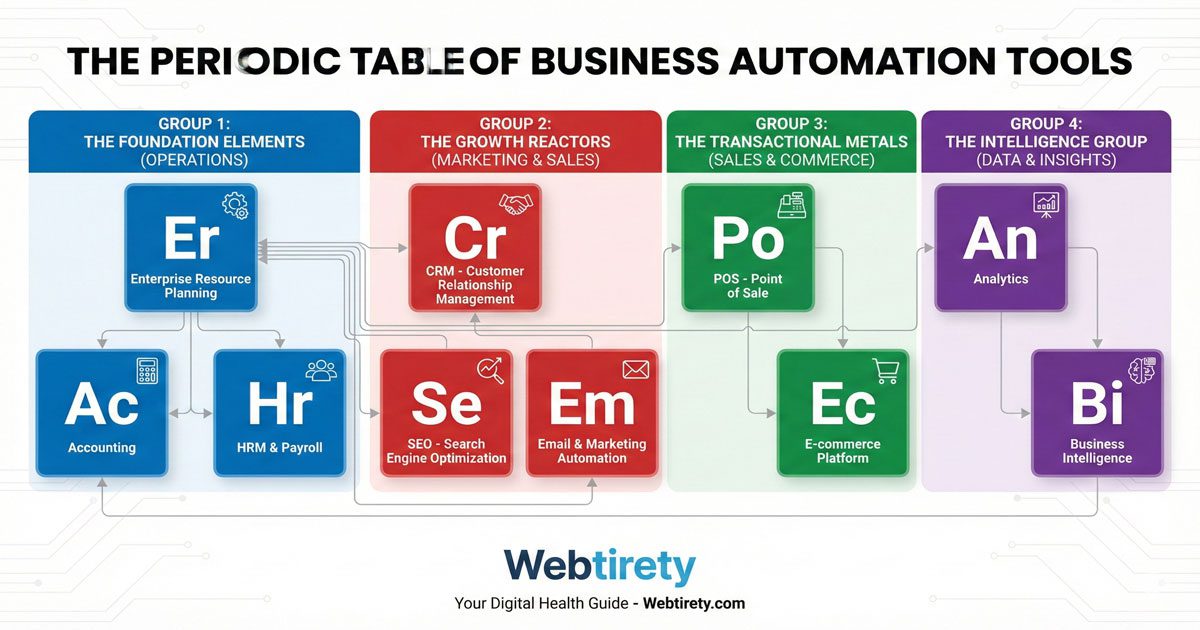
📊 The Infographic: Your Digital Tech Stack Visualized
This graphic organizes essential business technologies not by their atomic weight, but by their business function.
🔗 Share This Table on Your Site
Find this useful? Feel free to embed it on your own blog or resource page with attribution to Webtirety.
HTML
<textarea style="width:100%; height:100px;" onclick="this.focus();this.select()" readonly="readonly">
<a href="https://webtirety.com/dispatch/periodic-table-business-automation-tools/">
<img src="https://webtirety.com/dispatch/storage/sites/4/2026/02/The-Periodic-Table-of-Business-Automation-Tools.jpg" alt="The Periodic Table of Business Automation Tools by Webtirety" width="800" border="0" />
</a>
<br />Source: <a href="https://webtirety.com">Webtirety Software</a>
</textarea>
🧬 Decoding the Table: The Essential Element Groups
Just like noble gases or alkali metals, your business tools need to interact correctly to stay stable. Let’s break down the major groups necessary for a robust tech stack for startups and SMEs.
Group 1: The Foundation Elements (Blue)
The bedrock of your operations. If these are unstable, everything else collapses.
- Er (ERP – Enterprise Resource Planning): The central nervous system. It connects inventory, finance, and operations. Example: Webtirety’s Aeropos ERP for seamless operational control.
- Ac (Accounting): The scorekeeper. Essential for compliance, GST filing, and cash flow visibility.
- Hr (HRM & Payroll): Managing your most valuable asset – people. Automating attendance and payroll is crucial for scaling.
Group 2: The Growth Reactors (Red)
The elements designed to attract customers and generate revenue.
- Cr (CRM – Customer Relationship Management): The memory bank. Tracking every interaction with leads so no opportunity slips through the cracks.
- Se (SEO – Search Engine Optimization): The magnet. Ensuring your business is visible when local customers search on Google. Related: Our Tier-2 City Digital Transformation Report.
- Em (Email & Marketing Automation): The nurturing engine. Turning cold leads into warm prospects automatically.
Group 3: The Transactional Metals (Green)
Where the exchange of value happens. Speed and reliability are key here.
- Po (POS – Point of Sale): The cashier. Critical for retail and restaurants requiring fast billing and inventory sync. Example: Our Aeropos ERP and RestroFlow solutions.
- Ec (E-commerce Platform): The 24/7 storefront. Your digital shop that never closes.
Group 4: The Intelligence Group (Purple)
Elements that turn raw data into actionable insights.
- An (Analytics): Understanding user behavior on your website and apps.
- Bi (Business Intelligence): Dashboards that tell you why sales are up or down, not just if they are.
🩺 How to Perform a “Digital Health Check”
Look at the Periodic Table above and ask yourself three questions about your current business:
1. Are you missing essential elements? Are you trying to run a ₹5 Crore retail business (Group 3) using only Excel spreadsheets instead of a proper ERP (Group 1)? That’s a missing element that will cause instability.
2. Are your elements reactive? Do your CRM and your Email Marketing tools talk to each other? If your sales team has to manually copy-paste data from one system to another, your elements are not reacting – they are resisting.
3. Are you suffering from “Tech Debt”? Are you holding onto legacy “heavy metals” outdated, expensive on-premises software because it’s too painful to switch to modern, agile SaaS solutions like Webtirety Nexus? (All-in-One Business, Work & Team Management Software | Webtirety Nexus)
Conclusion: Finding Your Perfect Formula
You don’t need every element on this table to succeed. A small local café needs a different formula than a national manufacturing distributor.
The goal of digital transformation isn’t to collect the most tools; it’s to assemble the right stable compound for your specific business goals.
If your current tech stack feels more like a mad science experiment than a disciplined operation, it’s time for a review.
Need help assembling your business elements? > Book a Free “Digital Health” Audit with Webtirety Architects.
❓ Frequently Asked Questions: Business Automation & Tech Stacks
A business tech stack is the complete combination of software applications and digital tools a company uses to run its daily operations. This typically includes foundational tools like an ERP (Enterprise Resource Planning), growth tools like a CRM (Customer Relationship Management), and transactional tools like a POS (Point of Sale). A well-planned tech stack improves efficiency and data sharing across departments.
Your business is suffering from tool fatigue if your team spends more time managing software than doing actual work. Key symptoms include paying for multiple subscriptions that do the same thing, employees manually copying and pasting data between different apps, and a general reluctance from your staff to use the software you purchase.
The most essential automation tools for a new small business include a robust Accounting system for financial compliance, a CRM to track leads and customer communications, and a reliable POS or E-commerce platform to process transactions. Once these foundational elements are stable, you can add marketing automation and advanced analytics.
Software integration is critical because it eliminates data silos and costly manual errors. For example, when your E-commerce platform automatically communicates with your Inventory ERP, your stock levels update in real-time. This prevents overselling, reduces administrative workload, and provides a single, accurate view of your business health.
The choice between an all-in-one platform and separate tools depends on your business size. Growing SMEs generally benefit more from unified platforms (like Webtirety Nexus & Aeropos ERP) because it keeps subscription costs low and ensures data flows seamlessly without needing complex custom APIs. Highly specialized separate tools are usually better suited for large, complex enterprises.


I’m Manas Ranjan Sahoo: Developer/Founder of “Webtirety Software”. I’m a Full-time Software Professional and committed to expanding Webtirety Software into a thriving platform that empowers businesses and individuals alike. I love to Write Blogs on Software, Technology, eCommerce, SEO, and Digital Marketing.